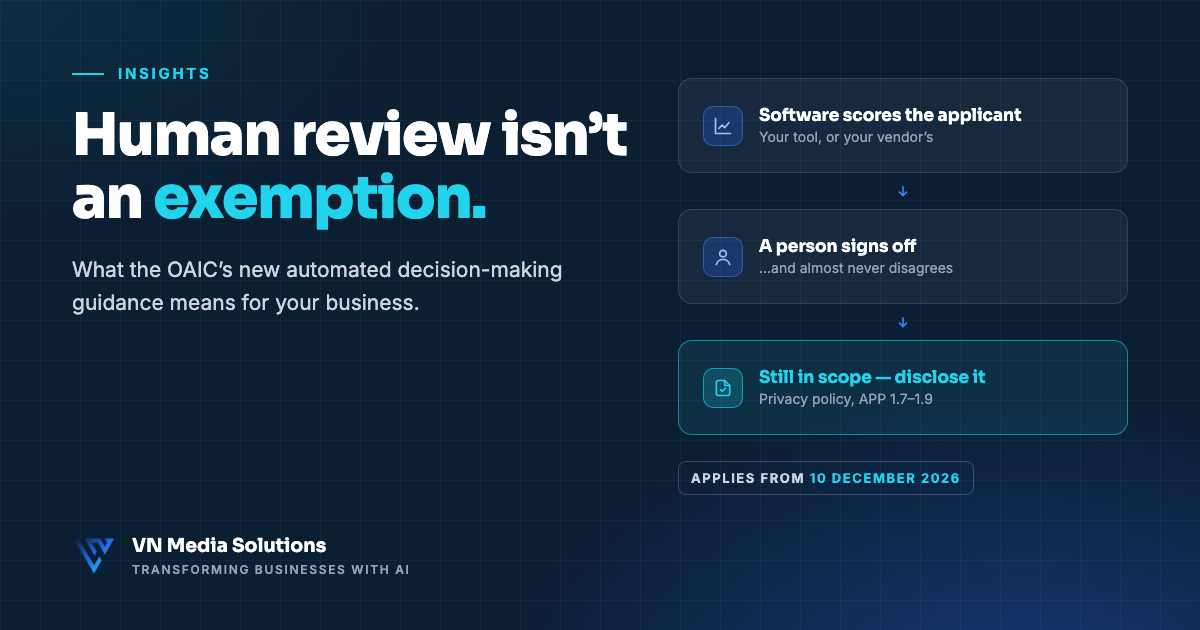
On 30 September the OAIC published its guidance on automated decision-making, the piece I flagged in July as missing. If your business uses AI or automation anywhere near a decision about a person, one line in it matters more than the rest: having a human review the output does not take that tool out of scope.
The guidance covers the new automated decision-making rule in Australian Privacy Principle 1, which starts on 10 December 2026. I wrote about the rule itself and whether it applies to you at the time. The short version: if you’re covered by the Privacy Act and a computer program helps make decisions that significantly affect people, your privacy policy has to say what information the program uses and what kinds of decisions it’s involved in.
What we didn’t have was the regulator’s reading of the grey areas. Now we do. The OAIC released a fact sheet, a flowchart and an updated APP 1 chapter, built from 90 written submissions. Three of its positions will catch out small businesses that thought they were safe.
A person signing off doesn’t take you out of scope
The rule covers a program that makes a decision, and also one that does something “substantially and directly related” to making it. The updated guidelines define “substantially” as being “a key factor in facilitating the human’s decision making”, and say plainly that a decision is still in scope “even where a computer program output does not replace the entire decision-making process or is subject to human review.”
That closes the most common assumption I hear: a person always has the final say, so this isn’t automated. If the person mostly follows what the software recommends, the software is a key factor, and you’re in.
The OAIC gives a list of factors for judging this, and they translate into four questions you can ask about any tool:
- How often does the human disagree with it? If the answer is “almost never”, the software is effectively deciding.
- Could they explain the outcome without it? A score nobody can unpack is hard to meaningfully review.
- Does it recommend, or does it rank and filter? A shortlist that silently drops people has already decided something about the ones who were dropped.
- How deep is it built into the workflow? When the score lands straight in the assessment screen, it frames everything the reviewer sees.
One of the guidelines’ own examples is an online marketplace where staff can override account suspensions but rarely do. The regulator treats that as high reliance on the program. An override nobody uses isn’t human judgement. It’s a rubber stamp.
Your vendor’s software is your responsibility
The rule applies when you have “arranged for” a computer program to be used. The OAIC expects the obligation to stay “with the APP entity who is using personal information to make a decision,” and that includes software you buy, subscribe to or contract out.
The examples are ordinary small-business purchases: an AI system bought in to screen job applications, third-party software that approves or declines refunds, a case management system that escalates certain complaints automatically. None of these were built in-house, and all of them count.
So “the CRM does that” isn’t an answer. You need to know what each tool decides, what it uses to decide it, and you should get the vendor to put that in writing.
Staff using ChatGPT can count too
This is the one that will surprise people. Among the guidelines’ examples of “arranging for” a program is an employer that permits staff to use AI chat tools to help with performance assessments.
That makes shadow AI a disclosure question, not just a data-leak question. If a manager pastes notes into a chatbot and asks it who should be promoted, or a team leader asks one to rank job applicants, your business may now have an automated decision your privacy policy doesn’t mention. The same goes for rostering, credit decisions on customer accounts and tenant shortlists.
The guidance also confirms the obvious limit. A human who makes the decision and uses software for something unrelated, like writing up the result in a word processor, is not captured. The line is whether the tool shapes the outcome, not whether it was open on the screen.
What to do before 10 December
If you followed the five-step preparation from July, you’ve done most of this. The new guidance changes the inventory step more than anything else.
- Re-run your inventory with the four questions above. Include tools where a person signs off. That’s where most of the hidden scope is.
- Add vendor tools and staff AI use. Ask each team what they use AI for, not just which systems IT approved.
- Ask your vendors what their software decides. Get it in writing and keep it with your contracts.
- Fix the review, not just the policy. If an override is never used, either give your reviewers the time and information to use it, or disclose the decision as effectively automated.
- Update your privacy policy. The OAIC wants it plain, specific enough to be meaningful, and grouped logically. You can describe decisions by category rather than listing every tool.
If your software assists rather than decides, the July sample paragraph needs one change. Something like this works:
We use software to help us assess rental applications. It uses the information in your application, including your rental history, income and references, to score applications. Our staff review every score before making a decision, and the score is a key factor in that decision. If you’d like to know more, or ask us to reconsider, contact us at [address].
Saying the score is a key factor is the honest version, and after this guidance it’s also the safer one.
Human review only counts if it’s real
I build AI systems with a human approval step by default, because I think that’s how they should work. This guidance doesn’t change that. It changes what the step has to be. A reviewer with the time, the information and the authority to say no is real oversight. A button someone clicks to keep the queue moving is not, and the regulator can now tell the difference.
That’s the useful part for a small business. Work out where the oversight is real, fix it where it isn’t, then describe it plainly. You end up with better processes, not just a longer privacy policy. If you’re working out where your own tools sit, I’m happy to compare notes. No pitch, just a conversation.
This article is general information, not legal advice. The sample wording above is a starting point for discussion, not a compliant policy for your business. For advice on your specific obligations, talk to a privacy lawyer.
Ready to put this into practice?
VN Media Solutions works with Australian businesses to implement AI agents, automate manual processes, and build the systems that make it all work.
Start a Conversation